The Book
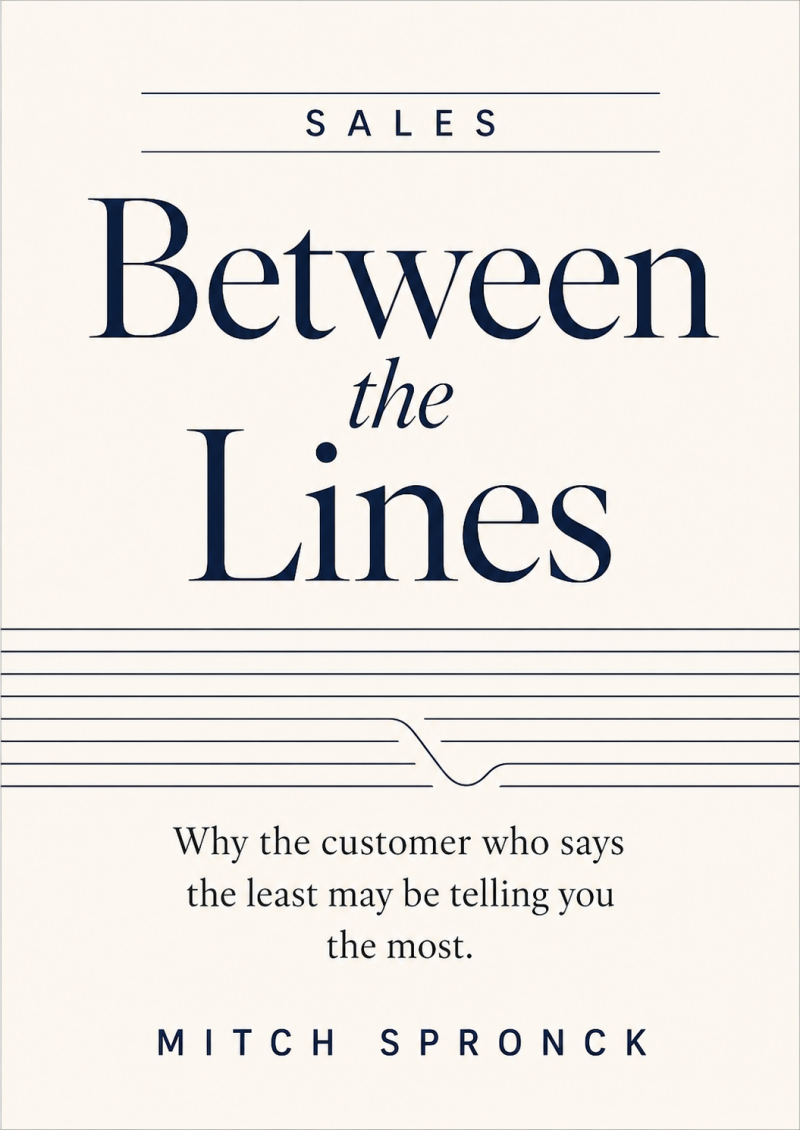
Sales Between the Lines
Why the customer who says the least may be telling you the most.
Complex sales decisions are rarely shaped by words alone. Sales Between the Lines explores the signals, patterns, context and stakeholder dynamics that sit around the explicit conversation — and how to interpret them without treating assumptions as facts.
Written for people working in complex B2B sales, the book looks at what changes, what gets overlooked, where decisions slow down and how different stakeholders can shape the same situation in very different ways.
What the book is about
Most sales books focus on what to ask, what to say and what process to follow. Sales Between the Lines focuses on something different: the information that appears around those conversations.
It looks at changes in behaviour, silence, questions, price friction, stakeholder dynamics and other signals that can help build a more complete picture of what may actually be happening inside a complex commercial decision.
What you'll find inside
Signals — noticing what changes
Context — understanding why the same signal can mean different things
Patterns — seeing the pieces together instead of in isolation
Stakeholders — understanding different perspectives and consequences
Friction — recognizing where and why decisions slow down
Validation — testing interpretations before acting on them
Who it is for
Sales Between the Lines is written primarily for people working in complex B2B sales, especially where decisions involve multiple stakeholders, technical considerations, long sales cycles or incomplete information.
Many examples originate in technical sales, but the underlying ideas apply wherever understanding the situation matters as much as understanding the words being spoken.
Why this book
This is not another step-by-step sales methodology.
There are no scripts to memorize and no universal meanings attached to individual behaviours. The book is about improving how you observe, interpret and validate what happens around a commercial conversation — so that you can respond to the situation you are actually in, rather than the one you assume you are in.